 Live Radio
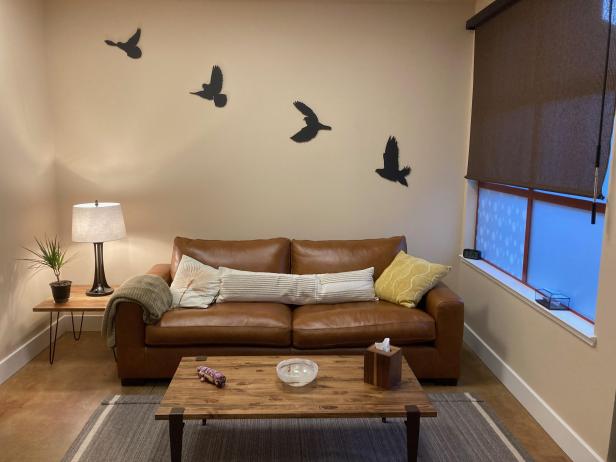 photo credit: Liminal Medicine
A room within Liminal Medicine's ketamine assisted psychotherapy clinic in Sebastopol.
Ketamine therapy has gained popularity in recent years.
First created in a lab in 1962, ketamine was historically used in veterinary medicine, and for surgical anesthesia in the Vietnam War.
But in the last quarter century, the psychedelic drug has been used in treatment for people suffering from PTSD - post traumatic stress disorder - successfully, including here in Sonoma County.
Liminal Medicine's nondescript clinic sits on a busy stretch of Highway 116 in Sebastopol.
The compact office with high ceilings and simply-adorned rooms feel warm, not just because of unseasonably hot early spring afternoon weather.
Liminal Medicine is a ketamine therapy clinic. Doctor Suegee Tamar-Mattis is medical director at Liminal.
"Ketamine's a very safe medicine, but it is a medicine, and it does have some side effects," Tamar-Mattis said. "It should be used under physician's care."
Tamar-Mattis and a team of licensed therapists see patients, like Azri, who often struggle with major mental health challenges.
"I was suicidal and my psychiatrist suggested it after we had tried basically everything," said Azri, a current patient at Liminal. "Outpatient, inpatient, every medication under the sun. So, she said I have something a little unorthodox for you to try and suggested ketamine therapy."
Azri first started ketamine assisted therapy while living on the East Coast, but has continued the treatment at Liminal since moving to Sonoma County.
Dr. Tamar-Mattis said there are lots of different medications and treatments for people with depression; things like SSRI's and cognitive behavior therapy, but she says those more conventional prescriptions are not silver bullets for every person struggling with depression or PTSD.
That's where psychedelic drugs - specifically ketamine in Liminal's case - have worked well for some like Azri.
"I felt a major difference from the first session," Azri said of her early experiences.
She said she's struggled for years with complex PTSD.
"My mind was constantly stuck in the past and I would have all these interrupting thoughts constantly every day thinking about traumatic events when I'm just trying to make dinner or work," Azri said.
For her, she said the results were almost instantaneous.
"The very first night after my session I noticed that my mind was quiet and that was a huge huge difference, and then after the initial, I believe it was 12 sessions, I didn't have ticks anymore and I wasn't suicidal anymore," Azri said.
Dr. Tamar-Mattis stressed that the benefits from ketamine assisted psychotherapy come when the drug is used in conjunction with therapy, not just on it's own, and she said that's the focus of the team of licensed therapists and clinicians at Liminal.
"That's how you get these long-lasting and and really deep results," Tamar-Mattis said. "Whereas you don't necessarily get them if you are just taking the medication and not doing the therapy. Which if you think about it, we know this, right? Because if somebody who has PTSD is taking MDMA at a rave, they still have PTSD the next day."
Psychedelics on the whole have been going through a kind of medical renaissance in the 21st century. The Food and Drug Administration labeled MDMA, a.k.a. ecstasy, a Breakthrough Therapy for PTSD in 2017.
That's the same year Tamar-Mattis said she first got involved with ketamine therapy. MDMA is still classed as a Schedule I drug though, the most heavily sanctioned designation in the United States. Ketamine is classed as a Schedule III drug by the federal Drug Enforcement Administration.
That means it's legal for use in specific settings, and in recent years it's really taken off, especially as a remedy for patients with the clinically-defined 'Treatment-Resistant Depression.'
"There's so many great things about ketamine that I really love and I feel really grateful to be able to work with it," Tamar-Mattis said. "It is one of the very few, if not the only psychedelic, that you do not have to wean anybody off any of their psychiatric medicines. So ketamine does not care what you're taking for the most part."
So what's the actual process like? Tamar-Mattis said patients at Liminal go through three prep and intake appointments before they're actually administered a dose of ketamine.
"They have to fast for four hours beforehand and you have to have someone drive you home," Tamar-Mattis said.
Once in session, as Tamar-Mattis describes the treatment, patients start with about a half hour speaking session with a therapist to get relaxed and ready for the psychedelic experience.
"So people will get in the reclining chairs and we'll put blankets on them because everybody gets cold in this medicine," Tamar-Mattis said. "We'll have blindfolds and we'll have music quiet calm music playing."
The next step is the ketamine injection, "and that will come on pretty quickly," Tamar-Mattis said.
"Then people get into the psychedelic space and, I would say we never leave anyone alone in the ketamine," Tamar-Mattis noted. "I don't think that's appropriate treatment at all."
Tamar-Mattis said a therapist is present with patients during the experience.
"The other great thing with ketamine is it's fast acting and it's kind of short acting," Tamar-Mattis said. "So you can have a very intense and deep psychedelic journey within a good 30 to 50 minutes, sometimes an hour."
Once a patient emerges from the psychedelic experience is when a therapy session typically begins.
"That is a place for some really rich and deep psychological work, right? You're getting some really deep therapy work," Tamar-Mattis said. "Then as you come more back into your body and you're able to eat, we'll bring you snacks and some water or juice and and then you're able to get up and then somebody can take you home."
Tamar-Mattis said it's been a goal of hers to make ketamine therapy more accessible to more people. To do so, Liminal recently partnered with a federally qualified health center in Sonoma County to bring ketamine assisted psychotherapy to more patients locally.
The plan, to help keep costs down, is to do group therapy sessions, which Tamar-Mattis said she's had success with in the past.
"When you're doing these ketamine groups, everybody has this like immediate connection with one another," Tamar-Mattis said. "I think just that human connection can be such a healing and important part of people coming out of their depression or PTSD or whatever is the issue."
Tamar-Mattis said the current ketamine therapy landscape is still changing. Although, Spravato or esketamine, a nasal spray ketamine medication, was approved by the FDA in 2019, major shake ups to the United States healthcare and regulatory environment during the second Trump administration have made some health care providers cautious about the use of experimental or controversial treatments like ketamine.
The high profile use and abuse of the drug by major figures like Elon Musk, and Matthew Perry, who fatally overdosed after taking ketamine with a cocktail of other drugs, has brought on renewed skepticism as well.
Still, Dr. Tamar-Mattis said she sees great hope for the patients who walk in Liminal's doors, those like Azri, who can find relief with ketamine's help.
 NPR
NPR Spotify