
 Live Radio
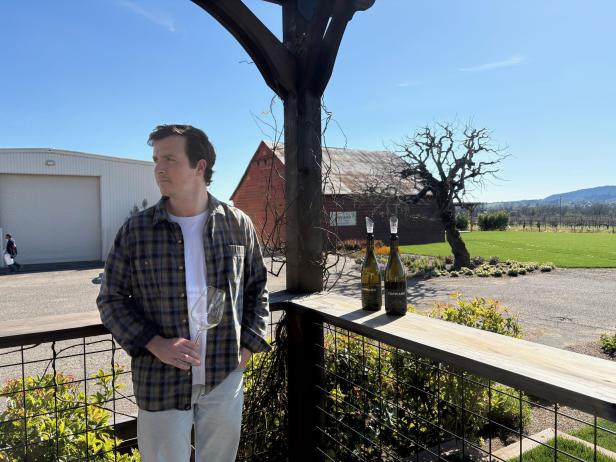 photo credit: Tina Caputo
Henry Cilek at Foppiano Winery in Healdsburg.
In case you’ve lost track, here’s a quick refresher on wine tariffs. In March last year, President Trump imposed tariffs on Canadian imports. Canada retaliated with tariffs on U.S. goods, and nearly all Canadian provinces stopped importing American wines.
Trump also imposed sweeping tariffs on products from the European Union — including winemaking and farming equipment.
Then, last month, the Supreme Court struck down the president’s authority to impose global tariffs under the International Emergency Economic Powers Act. For many local winegrowers, this was cause for celebration. Yet there appears to be little relief in sight.
“Farmers are incredible people, farmers and ranchers,” said Congressman Mike Thompson, whose district includes Sonoma and Napa counties. “They deal with more challenges in their day-to-day business life than just about anybody else.
“Labor challenges, equipment costs, fuel costs, and then to inject into an already difficult work environment a self-imposed, shoot-yourself-in-the-foot, illegal tariff. It's just crushing.”
According to a new report from the Wine Institute, 2025 was the most catastrophic single-year trade decline in the history of U.S. wine exports.
Wine sales to Canada dropped nearly 80%, and total global exports declined 35%.
That cost American wineries over $400 million in lost sales.
“Prior to the trade wars, we exported about $60 million a month to Canada, and now there's almost no imports,” Thompson said. “When you lose market share, and in this case, all of your market share, it's really tough to get any of it back.”
Though the USDA announced a $12 billion relief package for farmers at the end of last year, Thompson said it’s not enough.
Only a billion dollars of the fund is allocated for growers of specialty crops — like vegetables, tree fruits and wine grapes.
“A billion dollars to all the specialty crop growers does not even scratch the surface,” he said.
To make up the difference, Thomson introduced a bill in December called the Specialty Crop & Wine Producer Tariff Relief Act.
If approved, it could be a huge benefit to local vintners like C.M.B. Family of Wines. The wine group owns Martin Ray Vineyards in Santa Rosa and Foppiano Winery in Healdsburg.
“From 2024 — which ended up being the highest case volume export year in our company's history — into 2025,” said Henry Cilek, C.M.B.’s export director, “… by the end of the year, we saw 45% decline in volume.
Cilek said Canada accounted for most of the loss. But what he calls the “tit-for-tat gamesmanship” of retaliatory tariffs hurt exports to other countries, too. That’s because buyers couldn’t predict what their fixed costs would be for importing U.S. wines.
“A wine that I might export for fill-in-the-blank ‘X’ amount,” Cilek explained, “they weren't necessarily sure if it was going to be received on their shores and paid for at the rate that they're accustomed to typically. Or, if it would be 50% more expensive, 75% more expensive, 150% more expensive, because those numbers were changing in what felt like a day-by-day, week-by-week type of scenario.”
Consumer sentiment has also suffered because of the trade wars, Cilek said. At a recent international wine show in Paris, he said he didn’t see nearly as many visitors as in pre-tariff years.
“What was very noticeable was how much less wine I poured,” he said. “And it occurred to me while we had just as many meetings with the trade and people were optimistic about learning how to work together in these new times, the lack of consumers visiting the California pavilion was noticeable.”
Even small wineries that focus on the domestic market – like Monroy Wines in Santa Rosa — have taken a hit. Founder Adolfo Hernandez said tariffs have driven up the cost of essential winemaking supplies.
“We use French oak,” Hernandez said. “We use bottles made in France. We use corks made in Portugal and Spain. It's a worldwide industry.”
As an independent winemaker producing only 500 cases each year, he said any increase hurts his bottom line.
“A good barrel is not cheap — a good barrel is usually around $1,500,” Hernandez said. “You add 10% on top of that, it starts cutting into your margins.”
With the U.S. wine industry in the midst of a downturn, Hernandez noted, the tariffs are making things worse.
Though he says he was relieved by the Supreme Court’s ruling, he’s not surprised that the president is trying to reimpose worldwide tariffs through the Trade Act of 1974.
“I hope it doesn’t go through and I hope this whole tariff thing just falls by the wayside, Hernandez said. “But that's just the hope.”
Cilek said he expects his company, and lots of other California wineries, to apply for tariff refunds.

 NPR
NPR Spotify