
 Live Radio
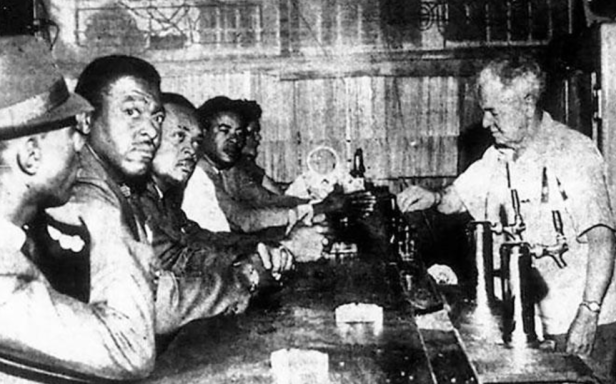 photo credit: Courtesy of the Press Democrat/Sonoma State University Library
A photograph from the May 1962 "sit-in" at the Silver Dollar Saloon in Santa Rosa.
60,000 Black people call Sonoma County home. And this week, several leaders in the Sonoma County Black community---from the local NAACP chapter, the North Bay Black Chamber of Commerce, Petaluma Blacks for Community and the Community Equity Foundation Incorporated---addressed the board of supervisors to mark Black History Month.
"While slavery in California is a well-documented subject of study and research, no one had looked at the impacts in Sonoma County," said equity advocate and former chair of the Sonoma County Commission of Human Rights D'Mitra Smith.
Smith added at the public comment podium, "what we find is that slavery is part and parcel of the development of the riches and resources of this county."
Smith spoke about the Sonoma County Slavery Historical Research Project, a collaboration between Sonoma County's NAACP chapter and Sonoma State University. It launched on Juneteenth 2023.
"Not only was there slavery here, but also resistance and advocacy," Smith said. "And a long history of activism from our community leaders who attended the California Negro Convention to contest the laws that prohibited non-white people from testifying in a court of law to Mary Ellen Pleasant, who purchased 900 acres and built Beltane Ranch to the Silver Dollar Saloon sit-in and our own NAACP [chapter with] over 70 years of history. We have a long history of activism here, it should be uplifted and taught in schools."
Rubin Scott is with Sonoma County's Community Equity Foundation. The organization behind the annual African Soul Festival in Rohnert Park.
"Being a young black man raised in Sonoma County, I have seen a lot and been targeted myself, but I also have seen a change," Scott said at the podium, directly addressing Supervisors David Rabbitt and Chris Coursey. "Having a nonprofit,---a black man in Sonoma County having a nonprofit---I want to say thank you because I have felt the support that you have given me, not only me, but my community. And that you continue to...thank you for seeing us, for making us visible, because that has been the key for us---not only to be here, but to be visible and be able to sustain. I want to say thank you for the work that you have done."
In February of 1926, Dr. Carter Woodson launched the first Negro History Week; the precursor to today's Black History Month.

 NPR
NPR Spotify